
Best Counties for Homesteading in Missouri
April 2026 · Based on federal data from 9 agencies
Missouri keeps showing up on homesteading shortlists for a reason the data backs up: the policy stack is unusually favorable. There is no statewide residential building code (RSMo Ch. 64), meaning dozens of rural counties have zero permit requirements in unincorporated areas. Constitutional carry took effect in 2017 (RSMo § 571.030). The right to farm is not just statutory — it is enshrined in Article I, Section 35 of the Missouri Constitution, passed by voters in 2014, requiring strict scrutiny for any law that restricts farming. Agricultural land is assessed at just 12% of productive value under RSMo 137.115, not market value — which translates to effective property tax burdens well below the statewide 0.88% average for working homesteads.
The harder question is where within those 115 counties. Missouri spans five distinct geographies and they do not behave alike. The Ozark Plateau in the south-central part of the state draws most of the homesteading attention — cheap land, abundant springs, and lax enforcement — but the karst topography means rocky, thin soils that frustrate row cropping. The Northern Plains offer rich glaciated loess soils ideal for production farming, but with higher land prices and more tornadoes. The Bootheel pushes into Zone 7b–8a with 210+ frost-free days, yet sits in the New Madrid Seismic Zone. The western prairie is good cattle country that doubles as tornado alley. And the Missouri River bottomland is the most fertile ground in the state — until it floods.
We pulled federal data from FEMA, Census ACS, NOAA, USDA, and five other agencies to rank all 115 counties across the dimensions homesteaders actually make decisions on. Here is what the data shows.
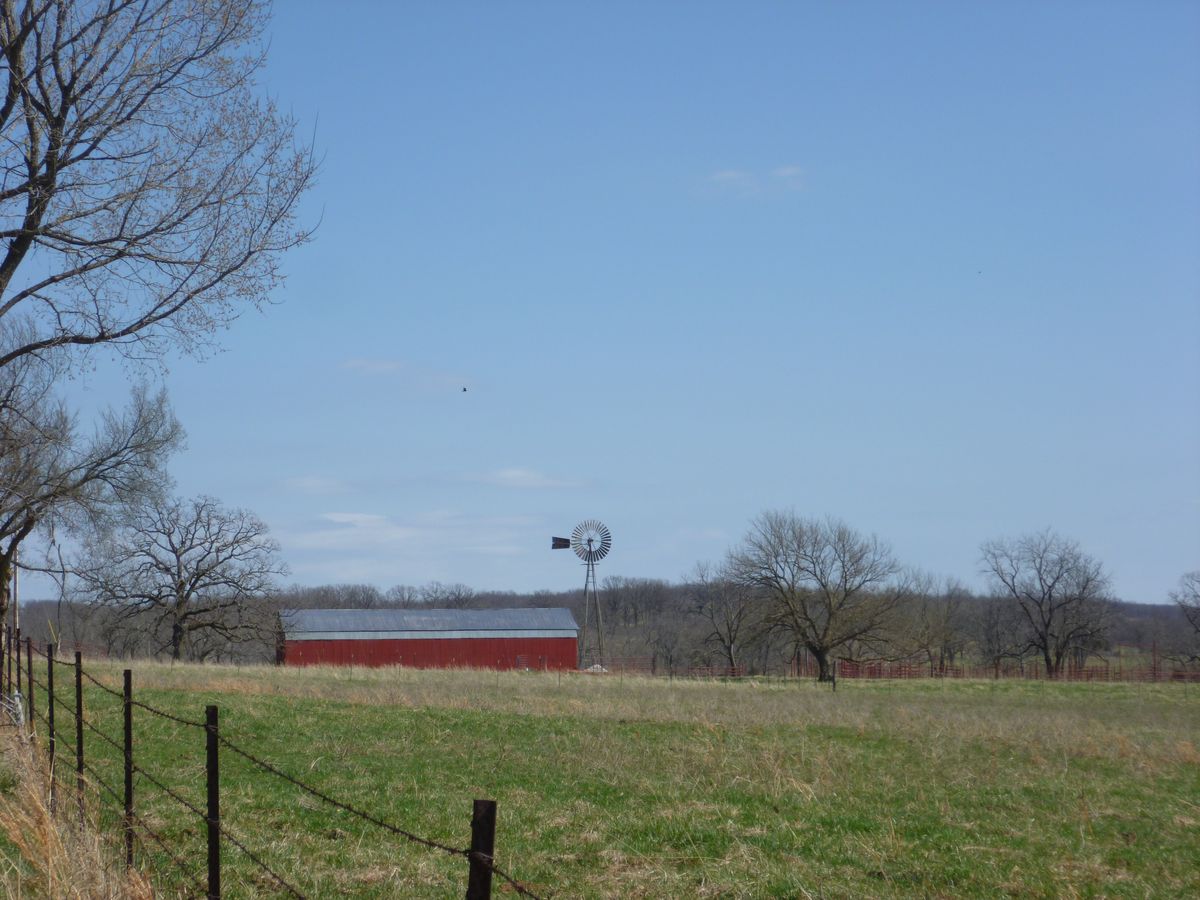
Rankings reflect county-level averages from federal data sources — your specific parcel will differ based on location, soil type, and local ordinances. This is a research starting point, not professional real estate or financial advice. See our methodology for data sources, freshness, and known limitations.
Missouri Counties
Click any county to view its full data profile. Colors show overall natural disaster risk from FEMA's National Risk Index.
Lowest Property Tax
Missouri's 0.88% effective rate already sits below the national average, but the real advantage is in the agricultural assessment. Under RSMo 137.115 and 137.021, farmland is assessed at 12% of its productive value — not market value — using an eight-grade soil productivity scale set by the State Tax Commission. A 40-acre tract with $200,000 market value but $60,000 productive value would be assessed at just $7,200 before local mill rates apply. There is no minimum acreage requirement in statute; qualification hinges on "active agricultural use" as determined by the county assessor. These counties already have the lowest baseline tax burdens before any agricultural classification.
| # | County | Property Tax | Median Home | Population |
|---|---|---|---|---|
| 1 | Reynolds County | $506 | $105,300 | 6,102 |
| 2 | Ripley County | $544 | $103,700 | 10,839 |
| 3 | Hickory County | $573 | $108,900 | 8,452 |
| 4 | Wright County | $577 | $141,600 | 18,475 |
| 5 | Wayne County | $598 | $110,000 | 11,081 |
| 6 | Oregon County | $614 | $115,700 | 8,783 |
| 7 | Shannon County | $654 | $141,600 | 7,132 |
| 8 | Douglas County | $655 | $148,900 | 11,803 |
| 9 | Texas County | $657 | $120,800 | 24,828 |
| 10 | Washington County | $659 | $112,300 | 23,580 |
Longest Growing Season
Growing season varies dramatically across Missouri. The Bootheel's Mississippi alluvial plain averages 210+ frost-free days with a last frost near March 20 — pushing into USDA Zone 7b–8a. Central Ozark counties run around 175 days (last frost mid-April). Northern Missouri's glaciated plains average 165 days with last frost as late as April 25. The 2023 USDA Hardiness Zone Map shifted much of Missouri half a zone warmer compared to the 2012 edition — something worth factoring if you are planning perennials or orchard trees. These counties top the NOAA frost-free data.
| # | County | Growing Days | Hardiness Zone | Precipitation |
|---|---|---|---|---|
| 1 | Dunklin County | 98 days | 7a | 36.2" / yr |
| 2 | Pemiscot County | 98 days | 7a | 36.1" / yr |
| 3 | Barry County | 96 days | 6b | 36" / yr |
| 4 | McDonald County | 96 days | 7a | 36" / yr |
| 5 | New Madrid County | 96 days | 7a | 36" / yr |
| 6 | Oregon County | 96 days | 6b | 36" / yr |
| 7 | Ozark County | 96 days | 7a | 36" / yr |
| 8 | Ripley County | 96 days | 7a | 36" / yr |
| 9 | Taney County | 96 days | 7a | 36" / yr |
| 10 | Butler County | 95 days | 6b | 36" / yr |
Lowest Natural Disaster Risk
Missouri's risk profile divides sharply by geography. The western prairie and central corridor see 30–45 tornadoes per year, with F2+ events averaging roughly eight annually. The Bootheel sits directly over the New Madrid Seismic Zone — USGS estimates a 28–46% probability of a magnitude 6.0+ earthquake within 50 years. Missouri and Mississippi River corridors experience major floods on roughly a ten-year cycle. The Ozark interior generally carries the lowest composite risk, though flash flooding in karst valleys is a localized hazard. These counties rank lowest on FEMA's National Risk Index.
| # | County | Overall Risk | Tornado | Flood | Disasters |
|---|---|---|---|---|---|
| 1 | Adair County | Very Low | Relatively Moderate | Very Low | 19 |
| 2 | Andrew County | Very Low | Relatively Moderate | Very Low | 22 |
| 3 | Atchison County | Very Low | Relatively Low | Very Low | 17 |
| 4 | Bates County | Very Low | Relatively Low | Relatively Low | 13 |
| 5 | Bollinger County | Very Low | Relatively Low | Very Low | 18 |
| 6 | Caldwell County | Very Low | Relatively Low | Very Low | 15 |
| 7 | Carroll County | Very Low | Relatively Low | Relatively Low | 16 |
| 8 | Cedar County | Very Low | Relatively Low | Very Low | 16 |
| 9 | Chariton County | Very Low | Relatively Low | Relatively Low | 17 |
| 10 | Clark County | Very Low | Very Low | Very Low | 18 |
Most Affordable (Median Home Value)
Missouri land prices follow a clear gradient from metro centers outward. Within 60 miles of Kansas City or St. Louis, expect $8,000+ per acre. Beyond 120 miles, prices drop to $1,500–$3,500 per acre in the Ozarks and southern counties. Pastureland statewide averages around $4,200 per acre (MU Extension 2025 survey), up modestly year-over-year. One warning from the forums: land flippers are repackaging stripped-timber Ozark parcels as "homestead-ready lots" at 3–4x fair market value. Check timber and soil quality before you buy, and always compare against recent sales in the county assessor's records.
| # | County | Median Home | Property Tax | Population |
|---|---|---|---|---|
| 1 | Shelby County | $85,900 | $786 | 6,049 |
| 2 | Worth County | $88,100 | $708 | 1,982 |
| 3 | Knox County | $89,000 | $787 | 3,772 |
| 4 | Sullivan County | $91,400 | $728 | 5,983 |
| 5 | Mississippi County | $92,600 | $809 | 12,305 |
| 6 | Dunklin County | $93,300 | $675 | 28,174 |
| 7 | New Madrid County | $93,400 | $684 | 16,341 |
| 8 | Pemiscot County | $94,900 | $941 | 15,555 |
| 9 | Harrison County | $95,900 | $825 | 8,190 |
| 10 | Atchison County | $96,100 | $1,070 | 5,270 |
Best for Off-Grid Living
Missouri is one of the more permissive states for off-grid living. Rainwater collection is legal statewide with no restrictions. Solar is unrestricted. There is no statewide building code — many rural counties (Shannon, McDonald, Lawrence, Douglas, Oregon among them) have no building permits, no zoning, and no code enforcement in unincorporated areas. The catch: septic systems are regulated statewide by the Missouri Department of Natural Resources, not the county. Even in "no-code" counties, you need a permitted septic system installed by a registered professional. Composting toilets are regulated county-by-county through on-site wastewater rules. The composite ranking below weights low property tax, high solar irradiance (NREL data), and low population density.
| # | County | Solar (kWh/m²) | Property Tax | Population |
|---|---|---|---|---|
| 1 | Reynolds County | 4.5 | $506 | 6,102 |
| 2 | Ripley County | 4.6 | $544 | 10,839 |
| 3 | Hickory County | 4.5 | $573 | 8,452 |
| 4 | Oregon County | 4.6 | $614 | 8,783 |
| 5 | Shannon County | 4.5 | $654 | 7,132 |
| 6 | Worth County | 4.3 | $708 | 1,982 |
| 7 | Wayne County | 4.5 | $598 | 11,081 |
| 8 | Ozark County | 4.6 | $703 | 8,688 |
| 9 | Carter County | 4.5 | $785 | 5,299 |
| 10 | Douglas County | 4.5 | $655 | 11,803 |
What to Watch Out For
Before you narrow your search to one county, these are the issues that catch buyers off guard most often in Missouri.
Septic is state-regulated, even in "no-code" counties
The absence of county building codes does not mean you can install your own waste system. The Missouri Department of Natural Resources requires a permitted septic system installed by a registered professional statewide (RSMo § 701.025 et seq.). This is the single most common surprise for buyers who assume "no building codes" means no permits of any kind. Budget $8,000–$15,000 for a conventional system, more in rocky Ozark terrain where excavation is difficult.
Ozark soil is cheap for a reason
Southern Missouri's Ozark Plateau has the lowest land prices and fewest regulations — and thin, rocky karst soils that frustrate row cropping. Many homesteaders end up trucking in topsoil and building raised beds rather than direct-planting. If your homesteading plan depends on field-scale production, focus on the Northern Plains counties or Missouri River bottomland where loess soils run deep. If you are oriented toward livestock, timber, orchards, and gardens, the Ozarks work — just calibrate your expectations.
Missouri is not a free-range state
You must fence all livestock in. If your animals escape and cause damage, liability falls on you as the owner. This is the opposite of open-range states where the burden falls on the neighbor to fence animals out. Budget for perimeter fencing before you stock any animals — and know that Ozark terrain makes fencing significantly more expensive than flat ground.
Land flipper markups in the Ozarks
Out-of-state land companies are buying stripped-timber Ozark parcels at $1,200–$1,400 per acre and relisting them as "homestead-ready" at 3–4x that price. Always check the county assessor's recent sales records and compare against the MU Extension farmland survey data before making an offer. If the timber has been clear-cut, the land may take 20–30 years to recover its productive value.
Utility costs to remote parcels
Running electric, water, or internet service to a remote parcel can cost $10,000–$50,000+ depending on distance from existing infrastructure. Get actual quotes from the local electric co-op and well driller before you close. Well drilling in the Ozark confining unit is technically complex and costs vary widely by county. Starlink has helped with internet, but deep hollows with heavy tree canopy and terrain still block signal.
Missouri at a Glance
Property Tax
0.88% effective rate
Ag land: 12% of productive value (RSMo 137.115)
Gun Laws
Constitutional Carry
Permitless carry 19+ (RSMo § 571.030)
Water Rights
Riparian
No permits for domestic/ag use
Right to Farm
Constitutional Protection
Mo. Const. Art. I, § 35 (2014)
Building Codes
No Statewide Code
Many rural counties: zero permits required
Homeschool
Low Regulation
1,000 hrs/yr, no state approval required
See the full regulatory breakdown on the Missouri state page.
Compare with your priorities
These rankings use equal weighting. Your priorities are different. Use the Location Finder to score all 115 Missouri counties with your own weights.
Related State Guides
Continue your research in other high-interest homesteading states. All guides use the same federal data sources.
 Kentucky
County rankings by property tax, growing season, disaster risk, and off-grid potential.
 Tennessee
County rankings by property tax, growing season, disaster risk, and off-grid potential.
 Arkansas
County rankings by property tax, growing season, disaster risk, and off-grid potential.